

James Esses’ Substack goes out to thousands of subscribers in over 80 countries. Become a paid subscriber to support James’ investigative journalism, gain access to his full archive of articles, and have the ability to post comments and join the conversation.
It seems that we are still in the process of emerging from an age of irrational beliefs in malign supernatural (i.e. anti-scientific) powers. Between 1542 and 1736, witchcraft in England was deemed to be a crime, dealt with initially by the church, and then, from 1562/1604, by the criminal courts. In 1736 Parliament passed an Act which repealed the laws against witchcraft, but which imposed fines or imprisonment on people who claimed to be able to use magical powers. This Act was then repealed by the Fraudulent Mediums Act in 1951, which in its turn was finally repealed as recently as 2008 (UK Parliament, 2026). But old beliefs die hard. The legal banning of witchcraft is now apparently to be replaced by the banning of exorcism, as the target of new legal powers under the Conversion Practices Bill.
Because it seems that exorcism is back in business again. Recent research on alleged conversion practices, carried out for Stonewall, claims to have found evidence of the widespread use of exorcism and enforced ingesting of ‘purifying substances’ in order to change someone’s sexual orientation or gender identity (Stonewall/Opinium, 2025). In 2014, Matthew Drapper underwent a well-documented case of exorcism, while taking part in a training course, a prayer ministry at the St Thomas Philadelphia Church in Sheffield. This was clearly a traumatic experience intended to change him from being gay to heterosexual, with past echoes of the Hammer Horror Film Studios. [During this exorcism] “MD asserts that [name redacted] exclaimed that ‘demons [can be seen] coming out of [MD] and leaving hand in hand, marching through the window’ (Richardson and Sarre, 2023: 31).
All good evidence for an essential criminal ban on conversion practices, perhaps? Except that, far from illustrating the need for a new criminal offence of ‘abusive conversion therapy’, Drapper’s case tends to illustrate the exact opposite. Despite the trauma experienced, Matthew Drapper was able to bring a successful legal case against the church under existing civil law for the tort (or ‘wrong’) of intentional infliction of psychiatric injury. He won a substantial five figure sum in compensation, but without the church formally admitting liability (Scorer, 2025). So his case clearly does not set a legal precedent as such. However, it does firmly establish that the existing civil law can be used as a strong deterrent against physical coercion aimed at changing sexual orientation.
And rather than introduce an untested blunderbuss of criminal law against conversion practices, simple recourse to the existing law might be both more effective and less of a fragile pawn in the current culture wars over sex and gender. Perhaps even making a few tweaks to the now creaking Equality Act 2010, in order to extend its narrow six-month window for bringing harassment claims, and recalibrating its partial exemptions for religious organisations, might well be enough for now. That is, unless we want to keep up the old traditions, by banning exorcism as a modern surrogate for banning witchcraft?
Government plans for conversion ban
Meanwhile, the Labour Government is busily putting together its final plans for a draconian criminal law ban on alleged conversion practices in England and Wales. However, the omens are still not looking good for this latest attempt to enforce such a ban. In Scotland, attempts at introducing separate legislation there quickly ended the political careers of two First Ministers, namely Nicola Sturgeon and Humza Yousaf. Banning conversion practices might no longer be such a high priority for Andy Burnham’s government, while still in its honeymoon phase. However, it was, after all, a definite commitment in the Labour Party manifesto, and one which is unlikely to just disappear.
The Bill has shifted ground, as previously recommended by the Cooper Report (2021), away from the nebulous concept of alleged conversion therapy, to the even more open-ended terrain of conversion practices. The Bill introduces a series of new criminal offences, and brings a yet wider range of suggested gender identities (non-binary, asexual, transgender) onto the statute book. It proposes new Conversion Practices Protection Orders, ostensibly to protect vulnerable victims. Critics have labelled the Bill as ‘unworkable’ (Beney & Jenkins, 2026: 10), and as “an impermissibly wide and dangerous Bill” (Mamdani et al, 2026: 32).
Research evidence on conversion
Any new legislation first needs to establish proof that it is both necessary and will be cost-effective in achieving its goals. This is set out in the Bill’s Impact Assessment (OEO, 2026). This claims that there is a growing literature on the scale and harmful effects of alleged conversion therapy/practices in the UK. But there is also gnawing unease about how robust that research base actually is, given that this is a highly politicised and contested research topic. According the damning forensic legal critique of the Bill produced by the Gay Men’s Network:
“There is no cogent evidence that conversion practices are widespread or a pressing issue in this country. Such surveys and statistics as have been cited are dubious and produced by self-serving actors with ideological prejudices” (Mamdani et al, 2026: 57).
This might seem to some of the Bill’s supporters to be an overly stark and dismissive evaluation of the research base for a new ban, however controversial its proposals. According to the OEO, “Multiple sources demonstrate that LGBT+ individuals report having been offered or experiencing forms of conversion practices” (2026). So, what is the actual state of research into conversion therapy/practices? (This term is used here to cover both aspects i.e. conversion therapy and conversion practices, despite the notional protective carve-out for therapists in the Draft Bill.)
Defining conversion practices
But perhaps, before answering this crucial question, we need to establish what do conversion therapy/practices actually consist of? According to the convoluted language of the Bill (CO, 2026), conversion practice means: any intentional conduct causing an individual to have (or believe) or not to have (or believe) that they have or do not have, a sexual orientation, or a particular sexual orientation, or a transgender identity or a particular transgender identity. So, perhaps this is not so very clear, after all?
And here the real problems begin. The Bill rests on an obviously false equivalence, in assuming that sexual orientation and gender identity are somehow parallel and comparable conditions. Yet sexual orientation is an observable behaviour, part of a broad spectrum of human arousal and desire. Gender identity is a concept, with no set or agreed criteria, which therefore renders it unfalsifiable as a self-diagnostic category. Gender identity is, in many ways, part of a belief system, a political ideology, or even a metaphysical stance. It depends on self-declaration and acceptance into a trans community. Elsewhere, I briefly set out a working model of gender identity ideology. This consists of the crucial concepts of gender identity, affirmation and entitlement; and the key processes of facilitating transition, promoting lived experience and achieving compliance by others (Jenkins, 2024). So the Bill essentially conflates trying to change a person’s sexual orientation (a behaviour) with trying to change a person’s gender identity (an internal belief system).
Classic gay aversion therapy
Of course, this issue is made yet more complex by the fact that there have been concerted attempts in the past to change a person’s sexual orientation, for both gays and lesbians, by the use of aversive techniques involving electric shocks and emetic medication. These interventions have been widely and correctly condemned as being inhumane and unethical, as well as being shown to be completely ineffective in permanently changing anyone’s sexual orientation.
However, there is little hard evidence that classic aversion therapy has been practised in the UK since the mid-1970’s. Davison’s overtly sympathetic survey indirectly confirms this: “[T]hroughout the 1960s and 1970s, when aversion therapy was at its height…” (2024: 11). A 1998 BBC documentary on aversion therapy for gay and lesbian people concluded that “demand for it has virtually disappeared” (see: Jenkins and Esses, 2021: 22). Jowett’s more recent qualitative study (n: 30) also found that “Aversive techniques were not reported by interviewees” (2021). Gay aversion therapy was, in any case, never accepted as being part of mainstream therapeutic practice within the NHS (Smith, et al, 2004: 431). In this regard, the government may be energetically trying to stamp out an aversive practice regarding sexual orientation which really faded from view more than 50 years ago. A heartfelt NHS apology for past distress and harm thus caused, and a well-funded compensation scheme, might well now be in order, but recounting past wrongs hardly amounts to a compelling case for fresh punitive legislation.
Taking stock of research on conversion
So, what does research tell us about now conversion therapy/practices aimed against gay people and people identifying as trans in the UK? According to the Office for Equality and Opportunity’s Impact Assessment, “There is a growing body of evidence that conversion practices are taking place in the UK today” (2026). The latter refers to a number of these reports, but the following table provides a more complete list for reference.
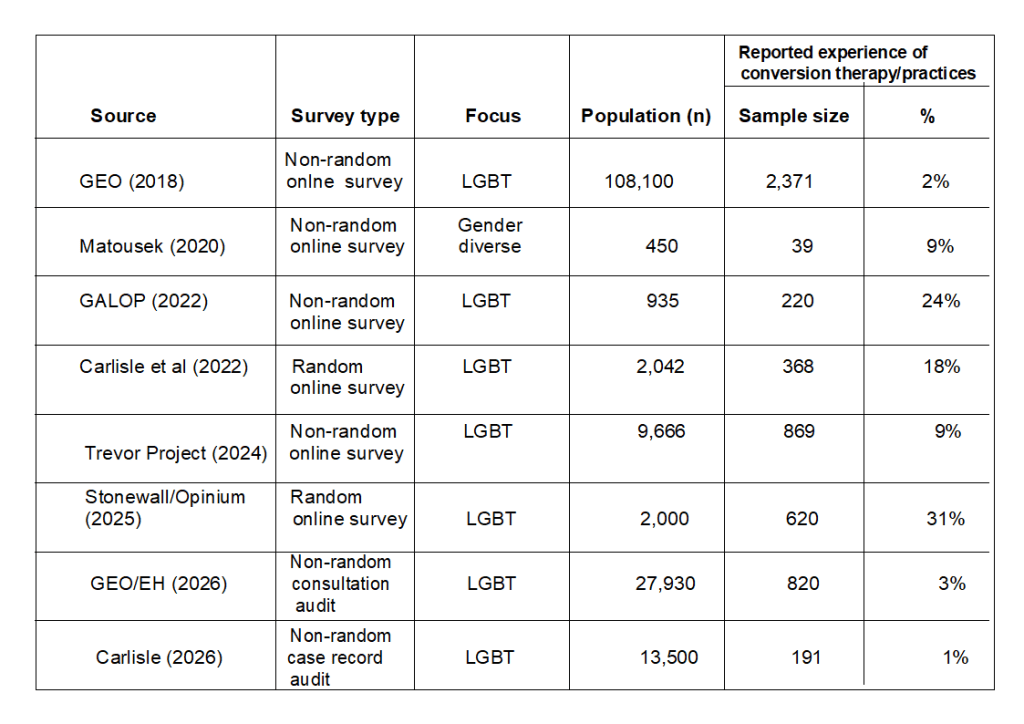
Table 1: Research findings from surveys of conversion therapy/practices in the UK.
The main starting point in exploring research into conversion therapy/practices is usually the Government Equality Office’s LGBT Survey (2018), which included four questions about alleged conversion therapy, as part of a much wider online self-report survey. This has been the largest survey to date in terms of its scale. This was a non-random survey, as are most of the other surveys. It is therefore is not representative of the wider LGBT population in the UK. According to the detailed critique by Jenkins and Esses: “Its methodology is seriously flawed – its starting definition of conversion therapy is to ‘change’, while the question actually posed in the questionnaire refers to ‘cure’, which implies a quasi-medical procedure” (2021: 19).
Evidence on prevalence of conversion
The ageing GEO 2018 Survey has been stoutly defended more recently by the Government Equalities Office/Equality Hub (GEO/EH, 2026), under the outgoing Keir Starmer government. The latter published, somewhat belatedly, a review of responses to a consultation exercise carried out way back in 2021-22. Again, by its very nature, this consultation review cannot contribute new knowledge about the likely prevalence of conversion therapy/practices.
The Matousek (2020) smaller-scale survey focused uniquely on gender diverse respondents, rather than the broader LGBT population. It is rarely mentioned in current discussion, and does not even appear in the OEO listing of reports. Several of the favoured reports are by GALOP, an agency specialising in work with LGBT people affected by sexual violence. Two of these (GALOP, 2022; Carlisle, 2026) are non-random surveys, which again cannot provide clarity about the prevalence of alleged conversion therapy/practices, i.e. how commonly these incidents occur.
Another GALOP survey (Carlisle et al, 2022) claims to be a random survey in terms of its methodology, in using an online interview administered to members of the YouGov Plc UK panel. The outcome results obtained are higher than for the GEO 2018 survey. This may partly reflect GALOP’s particular interest in establishing the need for a national helpline. This materialised soon afterwards, with GALOP being the only bidder, lavishly funded by the government to the tune of £360,000 (Sex Matters, 2026).
Government’s rationale for a new law
In order to establish a need for legislation, the government first needs to provide evidence that alleged conversion therapy/practices are a widespread problem. Yet the majority of the surveys available are non-random and therefore cannot be representative in statistical terms of the wider LGBT population. This critical failing applies to the GEO (2018), Matousek (2020), GALOP (2022), the Trevor Project (2024), GEO/EH (2026) and Carlisle (2026) surveys (see: Table 1: Research findings of surveys conversion therapy/practices in the UK). The Government’s own Impact Assessment (OEO, 2026) does grudgingly admit, buried deep, deep, deep down in its report, that “There is no representative data on the level of prevalence of conversion practices in England and Wales”. This casual aside does seem to blow a very large hole in its own case for enacting a new law.
So, caught on the back foot, the OEO now looks favourably on the Stonewall/Opinium (2025) survey, which is a random survey. However, this has produced implausibly high levels of conversion practices, i.e. 31% as a lifetime prevalence. This figure is far higher even than those produced by previous non-random surveys. The Stonewall/Opinium survey covers specific aspects of alleged conversion, such as exorcism and forced ingestion of purifying substances, broken down by regions. The results have been subject to sharp criticism. Sex Matters claim that the “the data are muddled and unreliable – the product of vague questions, opaque definitions, and a heavy dose of activist framing” (Sex Matters, 2025). Armstrong (2025) has pointed out that, if the data is correct, then exorcisms occur more than half as frequently as church weddings. Intuitively, this would seem to be somewhat improbable. Armstrong also suggests that “…sometimes surveys encourage motivated answers”. Surveying alleged conversion is hardly a value-neutral process, given that this is an extremely politicised topic. Activist pressure might therefore encourage over-reporting of alleged incidents. The results are also disproportionately London-centric.
The government has also turned towards the emotive Carlisle survey, ‘Still not illegal’ (2026) for more supportive evidence. Again, this is yet another non-random survey, using data drawn from case records of 191 clients using GALOP’s national helpline. The dataset is of poor quality, with an absence of basic demographic information regarding clients’ sexual orientation, ethnicity and religion. Other relevant data on clients’ sex and on their citizenship status is also missing. The survey points towards conversion being carried out abroad (2026: 20), the relative frequency of forced marriage in a third of the reported cases (2026: 30), and the coercive role of religious authorities, such as Mosques and Imams (2026: 33-35). It would seem that the research reflects much more accurately the specific experiences of GALOP’s traditional client base, rather than those necessarily found amongst a much more diverse LGBT population.
Parallels with reforming child protection law
It might also be worth thinking back to the closely related issues raised about reforming child protection law at the turn of the century. In the 2003 Inquiry into the tragic death of four-year-old Victoria Klimbie, it became clear that specific allegations of demonic possession had played a significant part in justifying orchestrating her carers’ neglect and violence towards her:
“…he formed the view that she was possessed by an evil spirit. He advised that the problem could be solved by prayer. …Two weeks after her first visit to his church, Kouao [PJ: Victoria’s carer] phoned Pastor Orome and told him that, following a brief improvement, Victoria’s incontinence had returned. He claims he reproached her for being insufficiently vigilant and allowing the evil spirit to return” (Laming, 2003: 35).
Part of the Inquiry’s job was to investigate whether the existing law to protect children was fit for purpose. Lord Laming concluded that “in general, the legislative framework for protecting children is basically sound. I conclude that the gap is not a matter of law but in its implementation” (2003: 6). So, we can perhaps deduce from this comment that, in his view, no new legislation was required in order to ban the metaphysical practice of demonic possession. The existing criminal law was judged to be entirely adequate to deter and punish behaviour which caused fatal or serious harm to its citizens, in this case to children aged under 18 years.
Ethical issues in making special legal protection for LGBT
If we were to follow Stonewall’s lead and acknowledge exorcism and the use of ‘purifying substances’ as a significant part of alleged conversion practices, then we might still come to the same conclusion as Lord Laming, namely that no new law is necessary. Because there is a very real ethical problem here in our producing a rapidly growing body of law providing special, heightened levels of protection for LGBT people, well beyond that available for other citizens. Criminal law normally depends upon evidence, proven beyond reasonable doubt, of mens rea, or harmful intention, plus proof of an actus reus, the guilty act by the accused. But increasingly, we now seem to require additional provision for a new category of meta-intention, or supposed justification for harmful actions. These harmful actions then require special consideration and the provision of ever higher levels of legal protection for victims, as under the Conversion Practices Bill (i.e. by banning ‘intentional conduct’ to change sexual orientation or gender identity).
But re-categorising criminal acts according to their presumed ideological intention towards special groups, as in the case of so-called ‘corrective’ rape, is simply unnecessary. It is potentially both demeaning and trivialising for other victims of ‘non-corrective’ sexual assault. As the authors of the Impact Assessment know only too well, whether labelled ‘corrective’ or not, rape is already a very serious criminal offence, punishable under s.1, Sexual Offences Act 2003. And, as with any crimes committed under the explanatory cover of witchcraft, exorcism and enforced ingestion of purifying substances, the overarching supposed metaphysical ‘justification’ for these crimes is completely irrelevant. This same principle should obviously equally apply to any offences committed in the name of carrying out conversion therapy/practices.
Conclusion
To conclude, the Gay Mens Network is correct: the research evidence of conversion practices does not stack up. Matt Drapper and his lawyers are also correct: current tort law can protect victims. With marginal exceptions, almost any crimes committed under the meta-intention of ‘conversion’ (itself a curious throwback to an obsolete religious discourse) are simply crimes, plain and simple. These laws are already listed in their dozens on the statute books. We need to use the existing law, not revert to laws against metaphysically intended harms like ‘conversion’. We no more need a new special criminal law ban on abusive conversion therapy than we ever needed a special criminal law ban in the past on witchcraft, exorcism, or even the use of purifying substances.
By Peter Jenkins, counsellor, supervisor, trainer and researcher in the UK (reprinted with permission of Critical Therapy Antotide)