

James Esses’ Substack goes out to thousands of subscribers in over 80 countries. Become a paid subscriber to support James’ investigative journalism, gain access to his full archive of articles, and have the ability to post comments and join the conversation.
Written by psychotherapist, Steve Perkins.
Ethical rules usually contain verbs: keep confidences, obtain consent, work within your competence. The wording can get technical, but the purpose is clear enough. They tell a therapist what they must do.
From 3 November, the British Association for Counselling and Psychotherapy (BACP), which represents around seventy thousand therapists, will make “anti-oppressive practice” a mandatory ethical principle for its members. This is not a proposal. The framework has been agreed and published, the supporting material is already in place, and the change has been made. It has been done.
BACP defines anti-oppressive practice as awareness of “relational power dynamics”, so that imbalances don’t “create or lead to marginalisation or minoritisation”. In doing so, language drawn from a particular way of understanding power, identity and institutions has been written into the ethical rulebook. Oppressors and oppressed. Even the language helps protect it from scrutiny: who wants to be accused of opposing “anti-oppressive” practice?
In the form BACP has built around it, the new principle reaches past conduct and into interpretation, directing the therapist’s attention towards power, privilege, group identity and structural inequality, and giving ethical authority to one contested way of understanding people. An ethical code tells therapists how to treat you. This one tells them how to interpret you.
Almost nobody outside the profession knows this is happening, even though these standards govern the people you might one day sit across from when you are distressed or unable to make sense of your own life.
Arguments about critical social justice and institutional standards are already playing out across universities and public life. It should concern us all when these ideas travel through professional training into mandatory codes of practice, especially in fields entrusted with people at their most vulnerable. Clients have a right to know what has been decided on their behalf.
The intellectual background isn’t hard to identify, because BACP is open about it. Its desire for social justice “determines everything we do”. Its Equality, Diversity and Inclusion strategy describes anti-oppression through “strategies, theories, actions and practices” intended to “equalise power imbalances”, while its training platform carries material on privilege, power, oppression and anti-oppressive supervision. This is a considerably larger undertaking than a commitment to being decent.
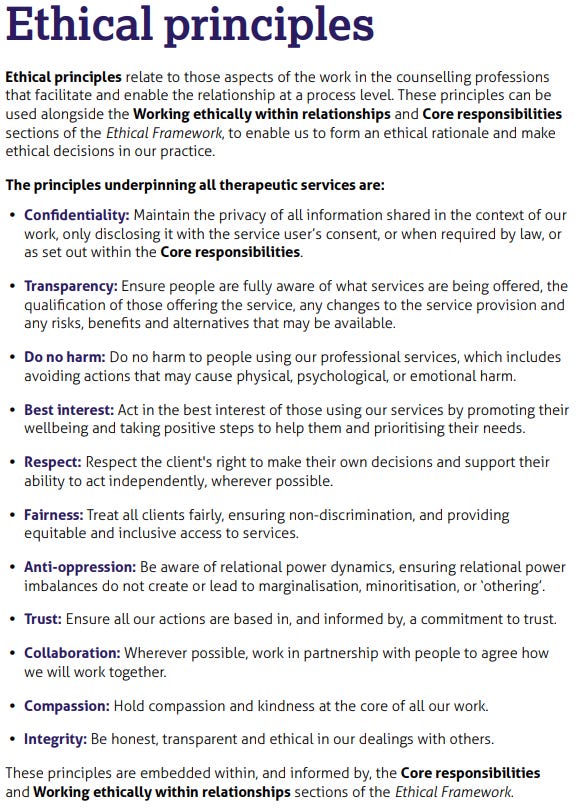
The clearest exhibit, though, came from BACP’s own President, writing in the members’ journal in October 2025. She described whiteness as “a whole social, political and economic system”, historically built on colonialism “in pursuit of domination”, and called for “decolonising whiteness”, “unlearning colonial patterns of thought” and “dismantling systems of privilege”. This was not a personal blog, but the President of Britain’s largest counselling and psychotherapy body, writing in the house magazine, setting out this worldview as though its claims were settled views that any decent person should hold. Nobody writes like that into a room they expect to argue with. The fact that she could write it this way tells us a good deal about the institutional culture around these questions.
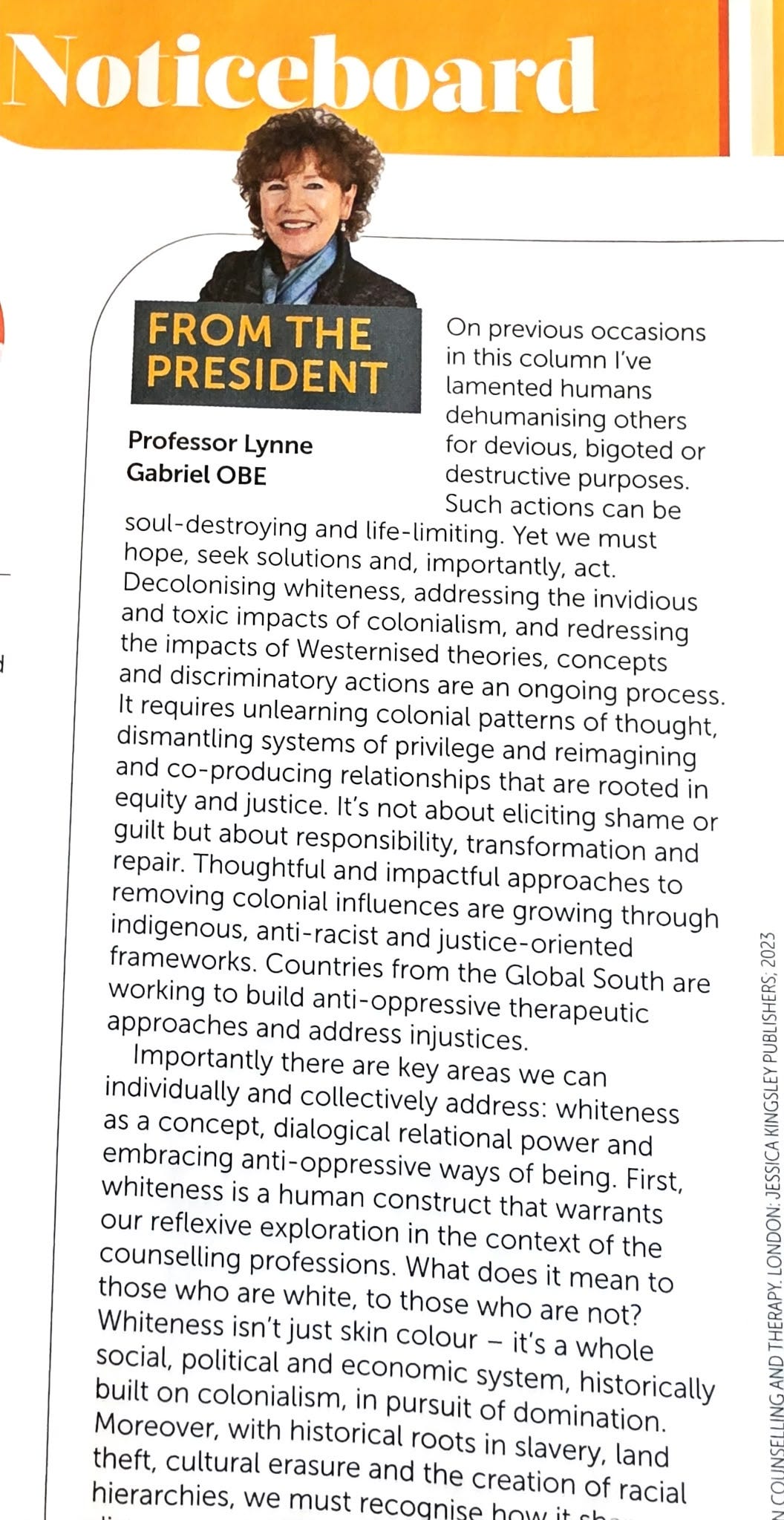
This family of ideas has now moved from being one interpretation among many into professional ethics, bringing an activist conception of counselling and psychotherapy with it.
A therapist who cannot see power, race, class or sex when they matter is half-blind. A therapist who must see them first has stopped following the person and started applying a syllabus. That is the kind of argument our profession must be able to have, and yet it hasn’t been possible to get BACP to acknowledge it.
That concern prompted an open letter signed by more than sixty practitioners and academics. Dr Nash Popovic and I asked BACP to affirm that no single ideological framework should become a condition of ethical competence. In its reply, BACP described anti-oppressive practice as an ethical commitment to recognising and proactively addressing disadvantage and discrimination. Nobody disputed either. Fairness was already in the code. A second principle sitting underneath it is not there to repeat “don’t be cruel.”
It is included precisely because it means more. Yet when asked what that more consists of, BACP has not given a clear answer.
We tried to remove this ambiguity in a resolution to BACP’s Annual General Meeting, asking it to affirm that anti-oppressive practice does not require adherence to one particular view of power and identity, and that informed disagreement remains compatible with ethical practice. The Board stopped the resolution before the wider membership could see it, without saying which of its three published grounds for refusal it relied on. The request was simple enough. Agreeing to it would have punctured the project.
When asked directly, BACP presents anti-oppressive practice in the mildest possible terms, while its own recent training and implementation material takes the principle much further.
In an official Ethics Essentials video produced as part of the framework review, members are told that fair treatment and good intentions aren’t enough, because a therapist may unwittingly fall into oppressive ways of being without meaning to or knowing it. Anti-oppressive practice, we learn, isn’t a competence that can be acquired. The therapist belongs permanently at the starting line, renewing the intention every session, in a rolling genuflection to power differentials and identity that can never be completed. It applies to every client, and therapists are told to assume that identities, named and unnamed, may be “active” even where the client has said nothing about them. The implication is that therapists must hold this in mind at all times to work ethically, regardless of whether a client has come to talk about difficulties at work, a marriage, or a panic attack.
These identities are treated as already there to be found, as though they were settled clinical facts that would show up on an X-ray, and the therapist’s job is partly to decode what they are and what they mean.
And how is any of this to be demonstrated? One of BACP’s consultants has devised an “identity wheel” on which therapist and client are mapped by social identity and power differentials, and the differences considered.
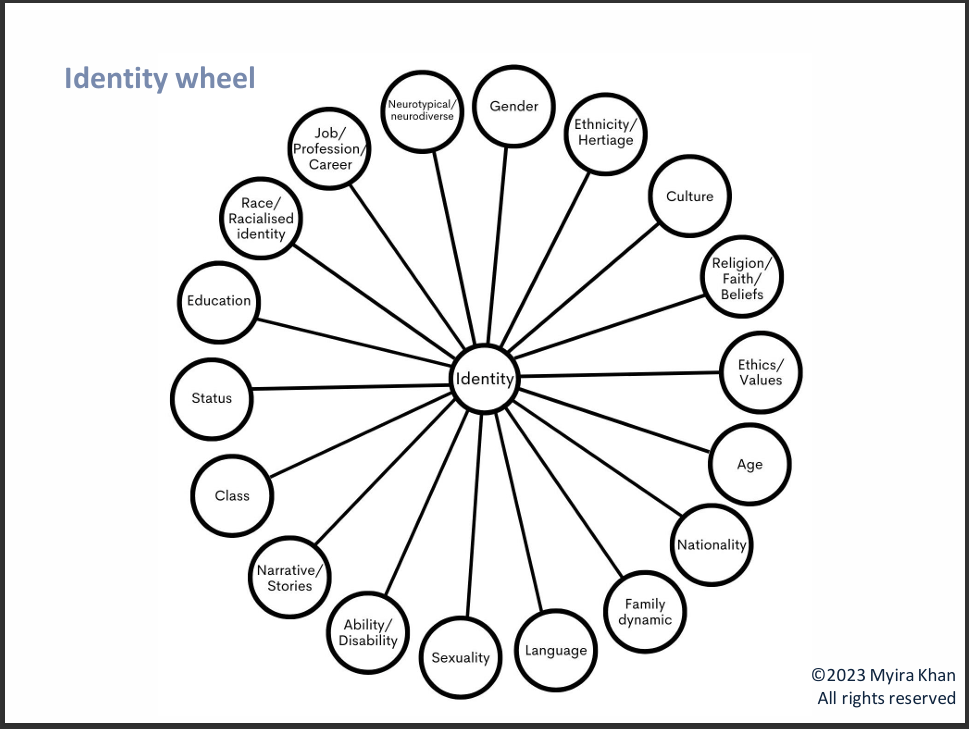
A profession that spent a century learning to leave its own apparatus outside the room has been issued with a diagram.
Some therapists may find that useful. Others will think that sorting client and therapist by identity, then drawing conclusions from those categories before the client has given them any significance, cuts against something basic in therapy: meeting the person in front of you as an individual. That is a legitimate clinical disagreement, yet BACP has given one side ethical prestige without saying whether the other remains compatible with good standing.
As far back as 2020, the Guardian reported the experience of a twenty-year-old woman it called Sana, in a case showing how a tilt towards “sorting into categories” can fail a client. She had been referred for therapy after her father’s death, with depression and anxiety. Her therapist, she says, began asking her out of the blue about forced marriage. Sana explained why she was there. The therapist returned to the one detail that had caught her attention: Sana’s Pakistani heritage. Sana felt she was being put “in a box”, found she could no longer open up, and after a few sessions the therapist suggested she might do better with somebody else.
The Guardian article presents this as a case for more cultural training. But a different reading is available: a therapist with a head full of framework, working hard to do the right thing, who never got round to listening to the person in front of her.
And this was six years before BACP made anti-oppressive practice a mandatory ethical principle. The client most likely to be misread is the client the principle was written for.
Therapy is asymmetric by design: somebody arrives distressed or uncertain and hands another person a good deal of interpretive authority, and part of that person’s job is to listen for patterns the client can’t yet see. If therapists have been formed to foreground power, privilege and structural identity, those explanations begin the session with professional backing, and the client learns soon enough which account of themselves makes most sense to share. Far from equalising power, it takes power from the client to decide what matters to them and where the work should go.
The client’s understanding can contract around the therapist’s worldview before they have finished discovering their own meaning, in a form of “therapeutic enclosure”. Everyone involved may be acting with entirely good intentions, which is precisely what makes it so difficult to see.
At the professional level, the same mechanism compounds and the problems go beyond simple conformity. As one family of explanations becomes easier to teach, praise and defend, the profession slowly loses fluency in the others. Agency, temperament, attachment, responsibility, grief and ordinary bad luck don’t disappear from human life, but they slide down the order of what practitioners are trained to notice. The result is epistemic thinning: a shrinking of both the range of people therapists can understand and the range of meanings available for understanding each person.
There is another cost, well away from therapy rooms. People don’t seek help if they suspect their suffering will first be weighed against their supposed privilege. Many already arrive feeling ashamed, burdensome, or uncertain that their problems are serious enough to justify being there. The suspicion that a therapist may be viewing them through a hierarchy of privilege could be enough to keep some away.
And the ones who stay away leave nothing behind. They don’t write to BACP to explain why they never booked the appointment. No adverse outcome is recorded, and the resulting absence of evidence can look reassuring precisely because the people put off by the culture remain invisible to it.
Therapy isn’t a vehicle for anybody’s politics, however humane they believe their worldview to be. A practitioner should be free to consider power, identity and oppression where those genuinely illuminate the person sitting opposite, and equally free to decide that some other account fits better. Most of all, the client should be allowed to work out what their own life means without a political framework having got there first. A profession dedicated to helping people find their own meaning has to stay capable of noticing how easily it can supply that meaning in advance.
Dr Nash Popovic co-authored the open letter and the AGM resolution described here, and commented on this article.
The full record, including BACP’s replies and its own materials, is here: https://stevejperkins.substack.com/p/bacp-2026-ethical-framework-anti-oppressive